
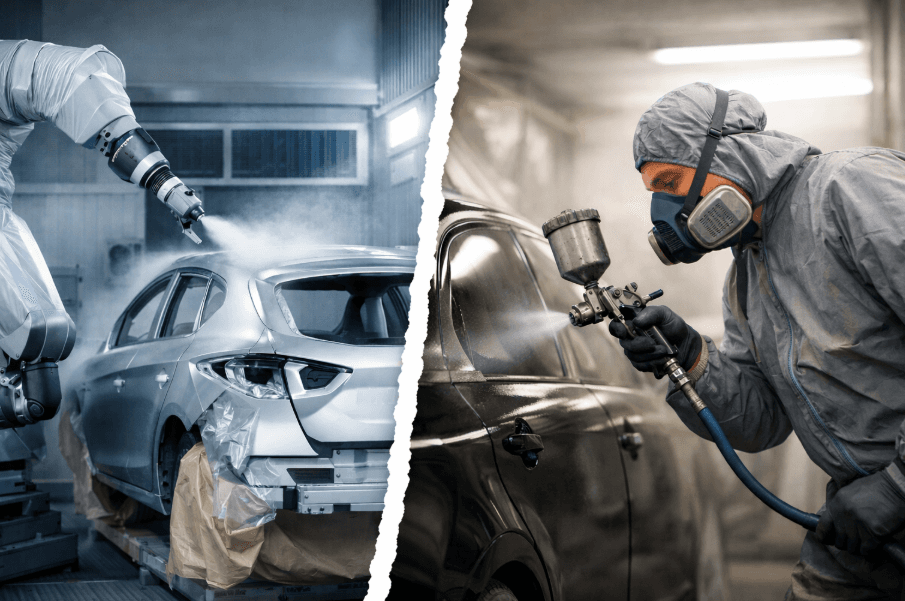
The automotive industry is an extremely demanding one where perfection of every aspect of vehicle manufacturing is expected, and the painting process is no less demanding. It takes precision, consistency, and efficiency to make a flawless finish.
We compare one to another, the robotic paint system vs the traditional manual painting technique, in our article.
Besides, we look into the past of painting technology to see how it has come to the present, study the parts of a robot that do the painting, and weigh the pros and cons of the methods.
We intend to find out which one provides better results in today's competitive market of today, after all.
The automotive industry has been using paint not only for beautification but also for protection purposes.
Therefore, to keep the quality of the finish at a high level and to minimise defects in the finish, robots are used in the painting process. Industrial paint serves as a vital layer that keeps cars safe from rust, UV damage, and other weather conditions.
The quality of the painting has to do with the lifespan and the appearance of the vehicle, which are very important when it comes to panel painting.
Car manufacturers want to achieve a finish that will make the car more attractive and will keep the value of the car after a period of time. Manual painting, which is labour-dependent and requires a skilled worker, is still in use.
The correct paint is one of the major reasons for customer satisfaction and brand recognition.
The continuous requests for better strength and attractiveness of the automotive products have been a source of innovation in automotive paint technology, which leads to new efficiency levels in automotive painting, and robots like Kuka are used.
Painting methods have undergone major changes from the past until today. For a very long time, people used to rely on manual painting, where the paint was sprayed manually.
After the invention of high-tech robots made for painting, this method became outdated. Nevertheless, this process requires a lot of work, and it is difficult to achieve uniformity, especially when a comparison is made between manual and robotic painting techniques.
Following a row of technological inventions, the automation of painting was developed, and they could use Kuka paint robots to carry out their activities. The painting technique of this case is highly discharge-consistent.
Even if these robotic painting installations are absolutely flexible in changeover situations and can easily tackle any new challenge, they still find it hard to identify the areas that have been previously painted and the ones that have just been repaired.
The transition to robotic paint is a sign of the industry's desire to improve the quality of the product and increase the productivity level, even though it is true that robots will still be able to work efficiently if they are properly programmed.
The quality of car painting is a vital factor in the automotive industry, and its significance cannot be lessened in any way, especially when a comparison is being made between shops that use robots to replicate the finish and those that paint 5000 panels by the traditional method.
A perfect finish not only makes the car visually more appealing but also keeps it safe from environmental factors, which is a very important thing for vehicles that have just been given some paint work.
If there are imperfections such as runs, drips, or uneven coverage, the vehicle's overall worth might go down. It is very important that the right amount of paint is applied during the process so as to avoid this.
To a great extent, the good application of paint depends on the art of painting, which requires the painter to be very exact, to have the same degree of work for the entire surface, and to be very careful with the details. The decision to have painting robots take over the job is being made more often.
Car manufacturers spend a lot of money on high-tech painting solutions to guarantee that each vehicle complies with the tough quality standards. In most cases, the result is what factory robots achieve that they want to replicate.
In the end, the quality of the painting job is a reflection of the manufacturer's pledge to be excellent and to satisfy the customer; thus, it is a big plus if the latest industrial robotic technologies are used.
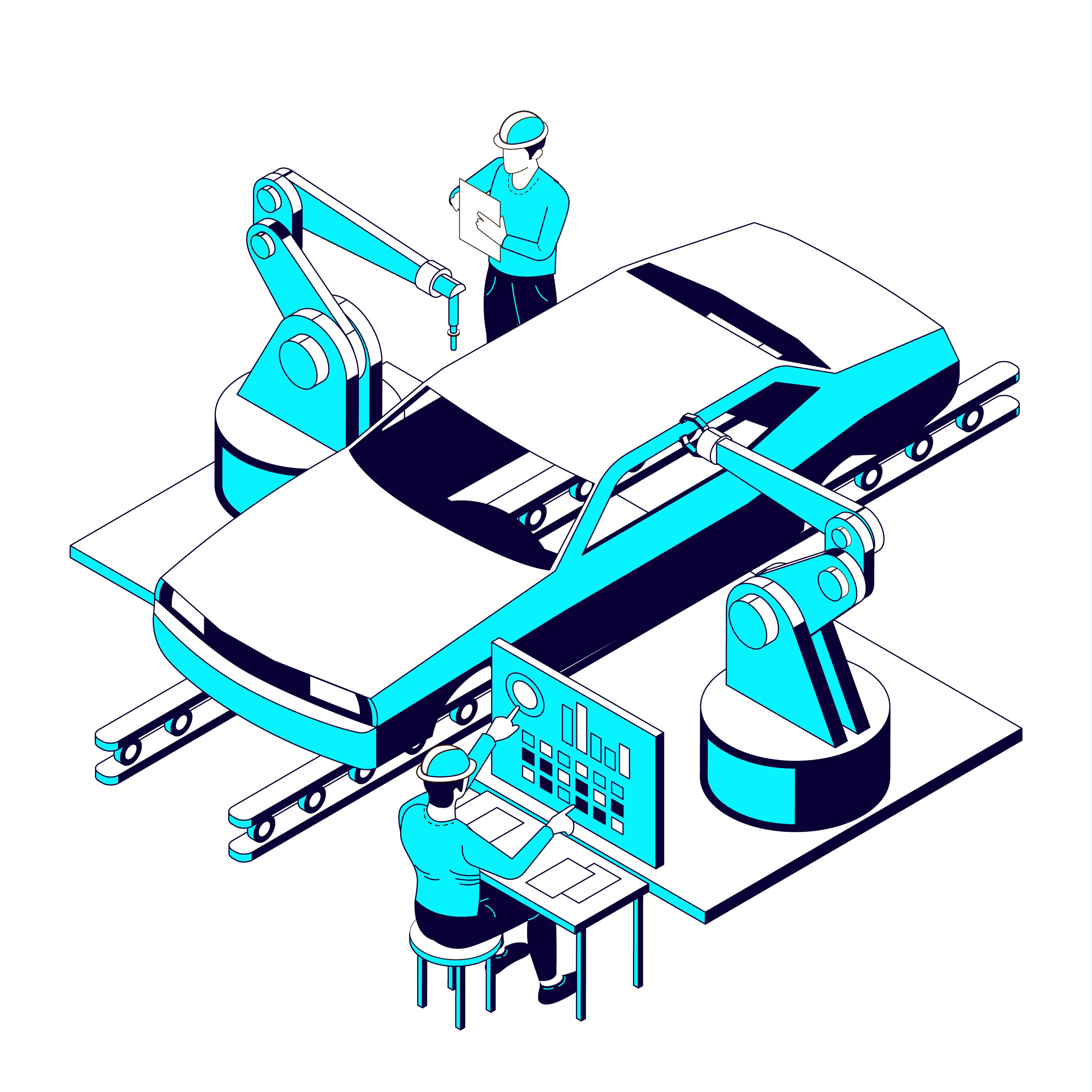
A paint robot is a system-powered device that is typically targeted at automating painting operations that help in the efficiency of the paint process, especially if the spray gun is less effective.
In general, these kinds of robots have prominent features that include the right to rectify the paint job and also the ability to keep uniformity across the shape of the area to be painted.
If you want to be sure that the robot follows the specific spray patterns you programmed it for, it is also necessary to have these patterns in the program so that the robot knows where to go, and it is also very important for the uniformity of the coverage and the paint thickness.
By using these machines to do the painting work that is usually done manually, the need for human labour is reduced, which also leads to cost-effectiveness, and at the same time, the overall efficiency is enhanced, and thus the paint waste is minimised, particularly in situations where five panels are being painted per day.
The most important function of the paint robot is to facilitate the application of the paint or any other types of coating materials on the surfaces, resulting in the desired finish with very little human involvement.
They are the essential elements of the industrial robotic system of the modern era in the field of painting automation.
Robotic painting equipment is made up of several essential components. Most important for the procedure are: the use of robots that would make accurate applications, the performance of the spray gun, and the capability of distinguishing the old paint from the newly repaired surfaces.
The paint booth provides a controlled environment, isolating the pollutants and ensuring the ventilation.
Advanced control systems program the movements of the robot and its coordination with the paint flow.
On their own, these components are separate, but they are interconnected and function as a single unit, thus delivering an efficient, automated painting solution of excellent quality.
Paint robots operate by adhering to pre-planned instructions that detail how paint is to be applied to a surface, thus making the spray gun less susceptible to errors.
The robot's movements are orchestrated with great precision to guarantee consistent coverage, and at the same time, very little spray is wasted, thus the overall efficiency of painting and coating processes is enhanced, which can be further increased by varying the spray hours.
In fact, the robotic arm takes the spray gun along an accurate route, always at the same distance and angle from the surface.
The control system changes the paint flow and air pressure to the best level for the application process; yet, paint match is still necessary for the right finish.
Being paint robots, they can continue to work for an indefinite amount of time without getting tired, thus the quality will be of the same level throughout the whole painting process.
They are a vital part of the present-day painting automation system; thus, efficiency and precision are maintained, especially when the spray gun is less effective for some applications.
Essentially, paint robots bring in consistent and accurate results that are far superior to the traditional manual method of painting.
To be exact, these robots are given the instructions necessary for them to execute certain spraying patterns, and thus, they can rightly apply the paint to the whole surface in a uniform manner.
Consequently, the method of randomly spraying different areas of the surface with paint can be almost completely done away with, as well as the possibility of runs, drips and thin spots which result from manual spray application.
Besides, the robotic arm is always at a fixed distance and angle, thus the result is a flawless finish without any abrupt changes or irregularities.
In fact, the consistency level that is attained here is of great value, especially in the car industry, where small imperfections can be easily spotted.
Paint waste has been a major problem in the automotive industry, a situation that can be reversed to a great extent by the use of paint robots.
The coat of paint is always applied efficiently in body shops using robots; hence, less paint is wasted.
Manual spraying is usually accompanied by overspray and uneven application, which results in the waste of paint. Paint robots, however, regulate paint flow and eliminate overspray through their exact control systems.
The robotic painting systems are the ones that install the paint only in the necessary areas, thus saving on material costs and lessening the burden on the environment.
Automotive producers can, therefore, make big savings in their production costs and improve their environmental footprint by giving less opportunity for paint waste to occur, at the same time ensuring that the original coat of paint is still there; but, paint match is very important for customer satisfaction.
Speed and efficiency are essential factors for car-making to be successful, and this is what paint robots are good at. Paint robots can operate non-stop and are not subject to fatigue; at the same time, they are able to maintain the quality of their work throughout the whole process.
Paint robots are able to complete the tasks of paint application in a time frame that is at least double that of a manual spray; thus, the production throughput is increased significantly, mainly in the case of five-panel painting; however, paint matching is still a vital issue.
Moreover, the implementation of painting automation lessens the requirement for manual labour; thus, the workers can be utilised for other tasks while ensuring that the correct amount of paint is applied.
The resulting speed and efficiency are lower production costs and shorter delivery times, which in turn give a competitive advantage to car manufacturers in a market where even luxury car owners demand quick turnaround.
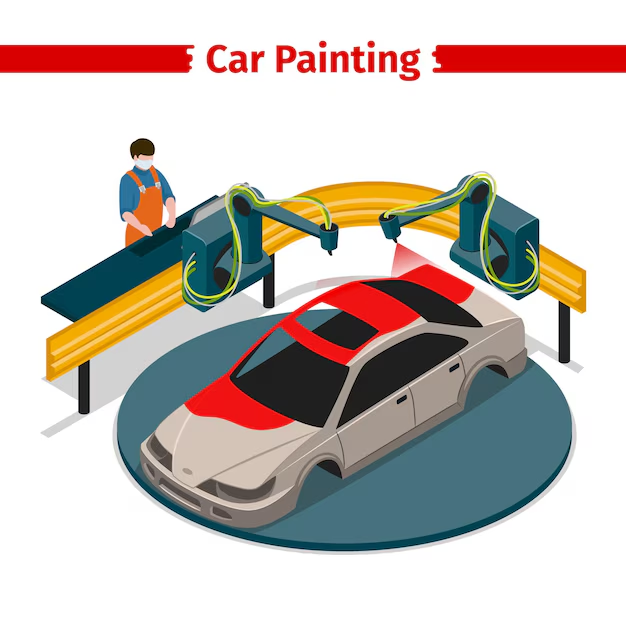
The initial investment and robot costs associated with robotic painting automation can be a significant barrier to entry, especially when reputable paint shops are able to offer competitive pricing.
Paint robots and robotic painting systems are complex and expensive pieces of equipment, requiring a substantial upfront investment, as industrial robots are insanely expensive.
The cost includes not only the robots designed for painting but also the necessary control systems, paint booth, and programming. Smaller body shops or those considering the option to get robotic painting may find it difficult to justify the initial expense, especially when the spray gun is less efficient than expected.
However, the long-term benefits of automation, such as reduced paint waste and increased efficiency, can offset the initial investment over time.
While paint robots offer a lot of advantages, the problem of their maintenance and downtime should not be overlooked, as they can make a considerable change in the efficiency of factory robots for painting.
Just like any other complex machinery, paint robots need to be maintained regularly if they are going to operate at their best.
The maintenance work may also refer to cleaning, lubricating, and replacing the parts that are worn out.
Therefore, the time set aside for maintenance or repair work can be the cause of production schedule interruptions and can lead to an increase in the plant's running costs.
Thus, automotive manufacturers have to consider these maintenance requirements when making a decision about the feasibility of painting automation, particularly in a market like India, where even the owners of luxury cars are very demanding of quality.
By ensuring that they are trained well and have a maintenance plan that is strictly followed, the paint robots can be kept for a short time during servicing, and their life can be prolonged up to the highest possible level.
Although robotic systems are highly advanced, they still have some limitations. A paint robot is ideal for a repetitive task with clearly defined parameters.
It might be the case that a complicated shape or a detailed design has to be done manually, even if it is a robotic paint process. In addition, they could struggle with any sudden changes in the way the painting is done.
A human painter is able to adapt to the shifts and even make instant corrections, while a robot might not have that capability.
Knowing these boundaries is definitely essential in determining at what locations and times it would be possible to use industrial robotic paint robots efficiently, and when there would still be a need for manual spraying in the paint process.
Need expert car painting? Whether robotic or manual, get the perfect finish for your vehicle with professional painting services.
Book your appointmentTraditional manual painting techniques usually mean that skilled workers use a spray gun to apply the paint. Such a method calls for very high expertise to get a uniform coating, especially in the application of the paint and making sure that the spray gun is less likely to create defects.
The painters have to control the distance, the angle, and the speed of the spray gun to prevent problems like runs, drips, and uneven coverage, and to make sure that the right amount of paint is being applied.
The quality of the finish is very much dependent on the skill and experience of the painter, but the overall result can be improved by a robot that makes precise adjustments.
Despite the fact that there are still some parts of the automobile industry where traditional manual painting is done, the process is gradually being replaced by painting automation because of the inconsistency and inefficiency of the former.
Generally, these ways of doing things require more time and as a result, more paint can be wasted, particularly when it is the case of painting five panels per day.
Traditional manual painting methods revolve around the skilled labour and craftsmanship of the artist.
In fact, the knowledge of a master painter, who has spent years of experience and has a profound understanding of how paint behaves, is often very significant when figuring out the best ways to fix the paint.
They can change their method to make up for differences in the painting area, temperature, and humidity, thus making sure that the paint formula and shape are used correctly every time.
Such a degree of flexibility is almost impossible to duplicate by industrial robotic painting automation when the peculiarities of the shape of the painting area are taken into account.
Manual painters usually relish the fruits of their labour; they make every effort to have a perfect finish by giving it their painstaking attention to detail.
Robots are capable of performing uniform paint application; however, they are devoid of the human touch and the artistic flair that skilled painters incorporate into the process.
Even though robot painting systems have become more popular, manual painting still has some advantages.
One of the main advantages is the ability to change, especially when robots are compared to manual painting, which depends on human skills and the capability of a person to adjust themselves and usually leads to the best case of painting five cars in a day.
Manual workers can simply adjust themselves to changes in the painting area or design, which makes it very good for low-volume production or custom paint jobs; however, they might be unable to handle the number of spray hours required for large projects.
They can fix defects immediately, without the need for a lot of programming or recalibration, but a robot is only helpful in achieving consistency rather than giving artistic flair.
Manually painting might be less expensive for small body shops or those who have limited budgets, as they do not require the substantial amount of money needed at the beginning for robots.
Furthermore, some people believe that manual painting offers a higher degree of detail and the work of a master, which cannot be imitated by robots.
Despite the fact that robot painting systems are getting more widespread, there are still some benefits in manual painting.
One of the main benefits is the capability to change, especially when robots are compared to manual painting, which is dependent on human skills and the capability of a person to adjust themselves, and usually results in the best-case scenario of painting five cars in a day.
Manual workers can simply adjust themselves to changes in the painting area or design, which makes it very good for low-volume production or custom paint jobs; however, they might be unable to handle the number of spray hours required for large projects.
They also have the capability of fixing a defect at once without a lot of programming or recalibration, whereas a robot is only helpful in achieving consistency rather than granting artistic flair.
Moreover, manual painting might be less costly for small body shops or those who have limited budgets, as they do not require the significant amount of money needed at the beginning for robots.
In addition, some people are of the opinion that manual painting provides more detail and the work of a master, which cannot be mimicked by robots.
When comparing the painted results of a robot to those of a human, it is very necessary to point out the advantages of each method individually, especially when some cars have just been repainted.
Paint robots are very good at delivering a consistent paint application, thus minimising the variation in thickness and coverage, which is the most important way of fixing the paint. As a result, the finish is totally uniform and complies with very high-quality standards.
On the other hand, manual painting, if made by highly skilled technicians, can bring very good results due to the dedication and the artistic skills of the painters, which is something that cannot be done by a robot that only makes uniform applications.
But manual methods have more safety issues because they can make mistakes due to human error and fatigue.
Deciding on the application of painting robots in different contexts involves a consideration of which of the three, consistency, precision, or customisation, one values most. In any case, they can do the job at a far greater rate than humans.
The robots in the plant are the ones that are carrying out the high-tech finishing, which is done automatically.
Flexibility in the stylistic elements and personalisation of the artwork plays a major role in the decision to use either robotic paint or manual painting.
The manual painting can be quickly changed to suit the new shape or design, while the spray gun is less efficient in achieving uniform results.
A skilled painter can find it very easy to change the technique to suit complex geometries or intricate patterns, something which is very difficult for a robot to be programmed to do. Robotic painting, being very accurate, still needs a lot of work for its program to be changed to handle different situations.
In this case, the robot will be extremely efficient for standard designs in high-volume production. However, manual painting may be a better option if you have low-volume custom jobs.
It is very important to know the exact requirements of the application to decide which solution is best, especially when considering the fact that paint is always thinner for certain applications.

The automotive industry is witnessing significant trends in robotic paint technology, driven by the need for increased efficiency and quality.
One of the key features of the inventions is the creation of more advanced paint robots, which would be made more accurate by the addition of improved sensors and control systems for the paint application.
The machines are now able to do more complex work, such as the application of more than one coating of paint with different thicknesses and textures.
The performance of the robots is improved by the innovations made in the design of their arms, which, therefore, affords them the ability to reach places that they could not previously, even though robots are ridiculously costly.
Besides that, machine learning algorithms are being used to regulate the spray patterns and thus reduce the amount of paint waste.
Essentially, the end goal is to have the deployment of painting robots that are complete in their automation and need hardly any human intervention, apart from yielding the best uniform results.
Besides handling diverse paint formulas, the sophisticated systems are also able to manage different shapes.
The growing implementation of robotic paint in the automotive sector, in consequence, will change the nature of jobs in that industry.
On one side, robotics might perform most of the tasks that have been done by painters, but on the other side, they can generate jobs in the field of programming, maintenance, and quality control, as these are the areas that are necessary for the efficiency of painting and coating.
Automation in painting might result in fewer manual painting jobs; however, it will also necessitate a workforce that is proficient in the operation and maintenance of these sophisticated robotic painting systems.
Car makers will have to put money into worker training and education to facilitate their adaptation to these new roles.
Ultimately, whether there will be more or fewer jobs will be determined by how the industry deals with this change, particularly since robots require programming to be efficient.
In the future, one can expect to see an overwhelming influence of automation in car painting.
There would be paint robots that are more evolved and can do the detection and correction of faults in the surface to be painted in a very short time, hence the application of the final layer of paint is always perfect.
New paints that are tougher, environment-friendly, and more beautiful may arise as a result of material science advances, thus paint will become a part of the vehicle that can increase its value.
With the help of artificial intelligence and machine learning as tools, paint robots will be able to continually improve their work by reducing paint waste to the minimum and increasing efficiency to the maximum, thus the robots will always be able to meet production demands.
As robots become more affordable and simpler to operate, even smaller body shops in India, where luxury car owners seek efficiency, will be able to progressively implement automated painting solutions.
At the end of the day, painting a car will be largely done by machines that will use data to achieve this, thereby yielding quality finishes that are standard and require little human intervention.
When we compare robotic painting with manual painting, we can gather several key points that mostly show that the efficiency of robots greatly speeds up the process.
A paint robot can deliver better consistency, accuracy, and productivity, while a traditional painting can give more freedom and make the product more personalised; both methods have their advantages.
Automating painting can be a major upfront investment, but in the long run, robots will save money by making the process less wasteful and by requiring less labour.
Hand painting is very dependent on the skill of the worker and the artistry of the craft, whereas robots need people who are good at programming and can do maintenance.
The right decision will be the one that meets the needs and takes into account the priorities of the car manufacturer, such as the number of products, the complexity of the painting process, or the level of quality desired.
Robotic paint is the best option for large-scale production situations where consistency and efficiency are very important, basically, when compared to traditional methods of painting. So, if the car manufacturer wishes to have top-quality and, at the same time, automate the painting process, robots are the ones to do it.
Paint robots, on the other hand, are very good at producing uniform results with little deviation when they are confronted with standard designs and repetitive tasks; thus, they represent the best example of painting five different vehicles within the same time frame.
Besides, robotic painting systems are also designed to use them for the application of multiple layers of paint or the coatings of different kinds; thus, they are the perfect ones for painting and coating tasks by using the advanced robot arms.
Automobile producers who will focus on cutting down on paint waste, lowering labour costs, and at the same time, strictly observing quality standards will be the ones to gain the most from the implementation of automated painting.
Even though robotic painting is more advantageous in many ways, manual painting still has its merits in some cases. Usually, the use of manual painting is chosen in small-scale production, custom paint jobs, or when thinking about the paint process for complex shapes that need a high degree of flexibility.
Experienced painters can adjust to changing conditions and make on-the-fly changes that robots may not be able to do, thus showing the difference between old paint and freshly repaired surfaces.
Moreover, manual painting might be a better option in terms of costs for small body shops or those who only have a limited budget, especially when the number of spray hours for larger jobs is taken into account.
Lastly, manual painting provides a certain level of artistic freedom and focus on detail, which is very hard to replicate robotically.
Choose the right painting method for your car. Book your appointment and get expert advice on the best painting solution for your vehicle.
Book your appointment